

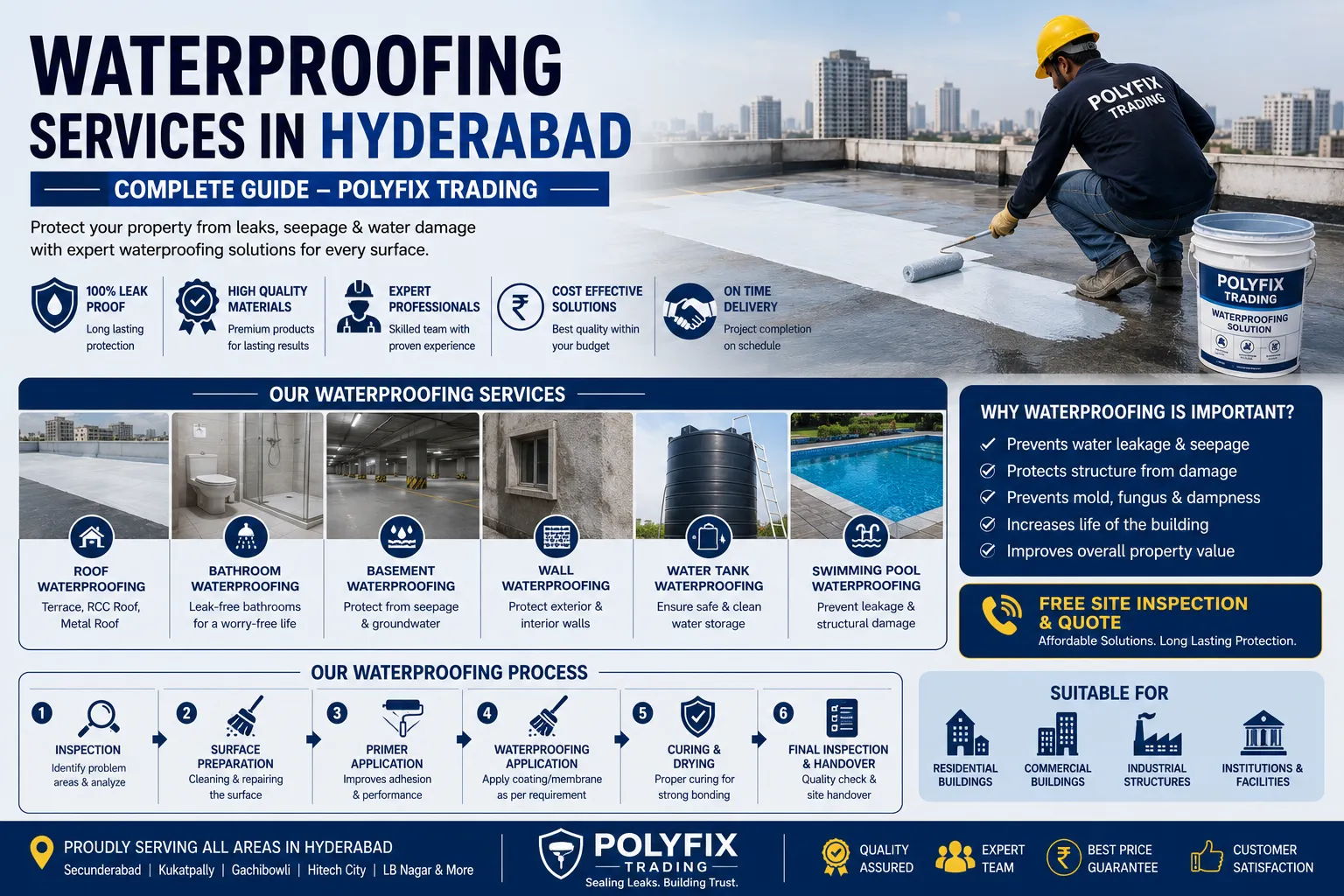
Waterproofing in Hyderabad homes generally falls into three categories — cementitious/integral admixture treatments (waterproofing compounds mixed into or coated onto concrete and mortar, governed in India by IS 2645), membrane waterproofing (bitumen felt, APP-modified, or PU-based membranes laid over roofs and terraces), and specialised systems like brick-bat coba for terraces or crystalline/injection grouting for basements. Which one a homeowner needs depends entirely on the surface — a terrace, bathroom, and basement each have different water-exposure conditions and need different treatment. This guide maps out every waterproofing service Hyderabad homeowners actually encounter, so you know what to ask for before you call a contractor.
Water damage rarely announces itself politely. It shows up as a damp patch on a bedroom ceiling months after the actual leak started on the terrace above, or as a musty smell in a ground-floor room that traces back to a basement wall with no visible crack. Hyderabad's monsoon (typically June through September, with the northeast monsoon adding rain into October–November) puts every exposed concrete surface — terraces, external walls, sunshades, balconies — under sustained water exposure every year. Waterproofing isn't a one-time cosmetic job; it's ongoing structural protection, and getting the type right for each surface matters as much as getting it done at all.
Why Waterproofing Matters Beyond "Stopping Leaks"
Water ingress into concrete doesn't just cause visible staining — it corrodes embedded reinforcement steel over time, which is what eventually causes structural cracking and spalling (concrete breaking away from the surface). This is a slow process, which is exactly why it's dangerous: by the time damage is visible, the underlying reinforcement may already be compromised. Waterproofing treatments — done correctly and redone on schedule — are what prevents that slow structural degradation, not just the immediate cosmetic problem of a wet ceiling.
The Three Categories of Waterproofing Explained
1. Cementitious and Integral Admixture Waterproofing
This is waterproofing built into or applied over the cement itself, rather than as a separate membrane layer:
- Integral waterproofing compounds are added directly into the concrete or mortar mix at the time of construction, making the concrete itself less permeable to water. In India, these compounds are specified against IS 2645 (Integral Waterproofing Compounds for Cement Mortar and Concrete), a Bureau of Indian Standards specification that sets requirements for setting time, compressive strength, and water permeability reduction when the compound is added to cement.
- Cementitious coatings are applied as a surface layer — a polymer-modified cement slurry brushed or trowelled onto walls, terraces, or bathroom surfaces — and are commonly used for internal wet areas and external walls because they bond well to concrete and masonry and can be applied by most contractors without specialised equipment.
This category is generally the most economical and widely used for bathrooms, internal wet areas, and general wall waterproofing, though it's less suited to areas with standing water or constant hydrostatic pressure (like basements below the water table).
2. Membrane Waterproofing
Membranes form a continuous, physically separate waterproof layer over the structural surface, and come in a few common forms used in Indian construction:
- APP-modified bitumen membranes — torch-applied or self-adhesive polymer-modified bitumen sheets, commonly specified in government (CPWD) specifications for terraces and roofs, often installed in multiple courses/layers for redundancy.
- Liquid-applied PU (polyurethane) membranes — a seamless, elastomeric coating applied in liquid form that cures into a flexible waterproof membrane, valued for terraces because it handles thermal movement and minor structural cracking better than a rigid coating.
- Prefabricated sheet membranes — factory-manufactured membrane sheets laid and lapped over the surface, used where consistent thickness and factory quality control matter more than on-site mixing.
Membrane systems are generally specified for terraces, roofs, and podium decks — surfaces with sustained standing water exposure and significant thermal expansion/contraction through the day.
3. Specialised Systems: Brick-Bat Coba and Basement Waterproofing
- Brick-bat coba is a traditional Indian terrace waterproofing method — broken brick bats laid in a graded lime or cement mortar bed over the roof slab, finished with a waterproof cement coating, providing both slope for drainage and thermal insulation alongside waterproofing. It remains widely specified in CPWD and government project specifications, often combined with an integral cement-based treatment.
- Basement and underground structure waterproofing deals with a fundamentally different problem — water pressure pushing against a structure from outside (hydrostatic pressure), rather than water sitting on top of a horizontal surface. This typically calls for a combination of external membrane treatment (applied before backfilling during construction), integral admixtures in the concrete mix itself, and sometimes crystalline waterproofing compounds that react with moisture inside the concrete to block capillary water movement.
Matching the Service to the Surface
| Surface | Typical Treatment | Why |
|---|---|---|
| Terrace / exposed roof | Membrane (PU liquid-applied or APP-modified bitumen) or brick-bat coba | Sustained standing water, direct sun/thermal cycling, needs slope + membrane + protective finish |
| Bathroom / wet areas | Cementitious coating, sometimes with membrane at floor-wall junctions | Constant but lower-intensity water exposure; needs to work around plumbing penetrations |
| External walls | Cementitious coating or integral admixture at construction stage | Wind-driven rain exposure rather than standing water |
| Basement / underground structures | Integral admixture + external membrane + crystalline treatment | Hydrostatic pressure requires a different waterproofing logic than horizontal surfaces |
| Sunshades / chhajjas | Cement mortar grading with waterproofing compound, per CPWD-style specification | Small area, high exposure, needs proper slope to avoid water pooling |
What Indian Standards and Specifications Actually Say
Two references come up repeatedly in Indian waterproofing contracts:
- IS 2645 — the BIS specification for integral cement waterproofing compounds, defining test requirements (compressive strength, setting time, permeability reduction) that a genuine waterproofing compound should meet. It's a useful reference point when a contractor claims to use "IS-compliant" waterproofing compound — it means something specific and testable, not just a marketing phrase.
- CPWD Waterproofing Specifications — the Central Public Works Department's technical specifications, used across government construction projects, detail specific method statements for terrace waterproofing (including brick-bat coba, APP-modified membrane courses, and integral cement treatments) and reference multiple BIS codes (including IS 2645, IS 1322 for bituminous felts, and others) as the technical basis for acceptable materials and workmanship.
Even for private residential work, referencing these specifications gives homeowners a way to hold a contractor to a defined standard rather than relying entirely on the contractor's own claims about quality.
How Often Should Waterproofing Be Redone?
There's no single number that applies to every surface and system, because service life depends on the treatment type, exposure conditions, and workmanship quality — but as a general pattern:
- Terraces and exposed roofs — the highest-exposure surface in most homes, generally needing re-inspection and potential re-treatment on a shorter cycle than internal wet areas, given constant sun, monsoon rain, and thermal cycling.
- Bathrooms and internal wet areas — generally longer service life if the original application was done correctly and there's no ongoing physical damage (tile movement, plumbing leaks) undermining it.
- Basement and underground treatments — service life depends heavily on whether the original treatment addressed hydrostatic pressure correctly at construction stage; retrofitting basement waterproofing after a failure is considerably more disruptive and costly than getting it right during construction.
The honest answer for any specific surface is to have it inspected periodically (commonly recommended before each monsoon season) rather than waiting for visible leakage, since damage is usually well underway by the time it becomes visible indoors.
Is Waterproofing Necessary for New Buildings?
Yes — arguably it matters more at construction stage than as a retrofit. Waterproofing built into new construction (integral admixtures in the concrete pour, membrane laid before other structural work is added on top, basement treatment applied before backfilling) is generally more effective and longer-lasting than retrofitting waterproofing onto an already-completed structure, simply because it can be integrated into the original detailing (slopes, joints, upstands) rather than worked around afterward. Skipping waterproofing at construction stage to save cost is one of the most common reasons homeowners end up needing more expensive remedial waterproofing within just a few years.
Is Waterproofing Covered Under Home Insurance?
Generally, no — not in the way homeowners often assume. Home insurance in India typically covers sudden and accidental water damage — a burst pipe, an overflowing tank, or storm/flood damage where the policy specifically includes it. It generally does not cover gradual seepage or leakage that develops over time due to deferred maintenance or the absence of proper waterproofing — which is exactly the kind of damage waterproofing is meant to prevent in the first place. In practice, this means waterproofing isn't something to defer on the assumption that insurance will cover the consequences if it fails — insurers specifically distinguish between sudden accidental events (which they'll typically pay out on) and gradual deterioration from inadequate upkeep (which they generally won't).
What Is the Best Waterproofing Method for Terraces?
There isn't one universal "best" method — it depends on the terrace's use, slope, and budget:
- Liquid-applied PU membrane performs well where the terrace has some existing minor cracking or irregular geometry, since it's seamless and flexes with thermal movement.
- APP-modified bitumen membrane is a well-established, widely specified option (including in CPWD specifications) for new construction or complete re-waterproofing, typically installed in multiple courses for redundancy.
- Brick-bat coba remains a proven traditional method, particularly valued because it combines waterproofing with thermal insulation and provides the slope needed for proper drainage — relevant in a city like Hyderabad where terrace heat gain is also a real concern alongside water ingress.
The right choice for a specific terrace depends on an inspection of the existing slab condition, slope, and how the terrace is actually used (accessible terrace vs. inaccessible roof), which is why a site visit — not a generic recommendation — should determine the final method.
Getting Started: What to Expect From a Site Inspection
A proper waterproofing assessment should look at each surface separately rather than quoting a blanket treatment for the whole building — checking for existing cracks, slope and drainage adequacy, plumbing penetrations, and any signs of existing water ingress (staining, efflorescence, dampness) before recommending a specific system for each area.
Frequently Asked Questions
What types of waterproofing services are available?
The main categories are cementitious/integral admixture treatments (compounds mixed into concrete or applied as a surface coating, per IS 2645), membrane waterproofing (APP-modified bitumen, liquid-applied PU, or prefabricated sheet membranes), and specialised systems like brick-bat coba for terraces and crystalline/external membrane treatment for basements. The right choice depends on the specific surface and its water-exposure conditions.
How often should waterproofing be redone?
There's no single fixed interval — it depends on the treatment type, exposure level, and original workmanship quality. Terraces and exposed roofs generally need more frequent inspection than internal wet areas given constant sun and monsoon exposure, and the safest practice is periodic inspection (commonly recommended before monsoon season) rather than waiting for visible leaks to appear.
Is waterproofing necessary for new buildings?
Yes, and it's generally more effective when built into construction from the start rather than retrofitted later, since integral admixtures, membrane layers, and basement treatments can be properly integrated into the original slopes, joints, and detailing. Retrofitting waterproofing after construction is usually more disruptive and costly than doing it correctly the first time.
What is the best waterproofing method for terraces?
There's no single universal answer — liquid-applied PU membrane suits terraces with existing minor cracking or irregular surfaces, APP-modified bitumen membrane is a well-established option for new or complete re-waterproofing, and brick-bat coba combines waterproofing with thermal insulation and proper drainage slope. The right method depends on an inspection of the existing terrace condition and how it's used.
How long does waterproofing last?
Service life varies by system and exposure — a well-executed, correctly detailed treatment on a properly maintained surface can last many years, while poor workmanship, subsequent structural cracking, or ongoing physical damage (tile movement, plumbing leaks) can shorten that considerably regardless of the material used. This is why workmanship and detailing at joints and penetrations matter as much as the waterproofing material itself.
Is waterproofing covered under home insurance?
Generally not for the gradual seepage or leakage that inadequate waterproofing typically causes. Indian home insurance policies usually cover sudden, accidental water damage (a burst pipe, tank overflow, storm damage where included) but exclude gradual deterioration from deferred maintenance — which means waterproofing needs to be treated as preventive investment rather than something insurance will cover after the fact.
What's the difference between cementitious and membrane waterproofing?
Cementitious waterproofing is either mixed into the concrete/mortar itself or applied as a bonded surface coating, making it well-suited to bathrooms, internal wet areas, and general walls. Membrane waterproofing forms a separate continuous waterproof layer over the surface, generally better suited to terraces and roofs that face sustained standing water and significant thermal movement.
Do I need different waterproofing for a basement than for a terrace?
Yes. A terrace deals with water sitting on top of a horizontal surface, while a basement faces hydrostatic pressure pushing water against the structure from outside. Basement waterproofing typically needs a combination of integral admixtures, external membrane treatment applied before backfilling, and sometimes crystalline waterproofing — a different approach than the membrane or cementitious systems used on an exposed terrace.
Book a free waterproofing site inspection with Polyfix Trading — get a surface-by-surface assessment and the right waterproofing recommendation for your terrace, bathroom, basement, or external walls.