

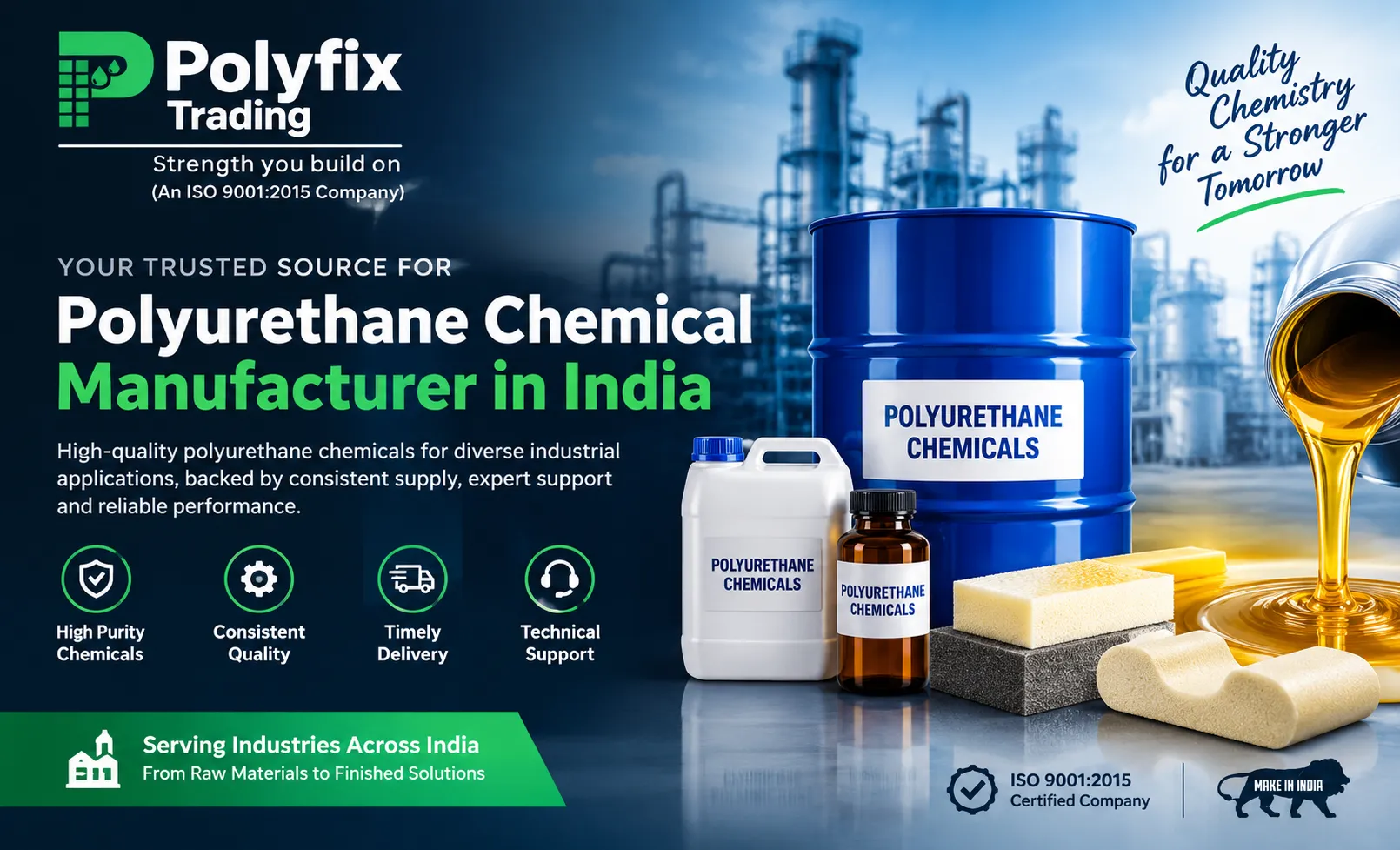
A polyurethane chemical manufacturer formulates and produces the chemical systems used to make polyurethane materials, including the rigid foam used for thermal insulation. For industrial buyers, the choice of manufacturer affects product consistency, technical guidance and how smoothly a requirement moves from enquiry to supply.
Polyurethane chemistry sits behind many industrial materials. Rigid PUF (polyurethane foam) chemistry matters most in cold storage, refrigeration, HVAC and building insulation. This guide explains what polyurethane and rigid PUF chemicals are, what a manufacturer does, and what to check before you buy.
It also introduces Polyfix Trading, a Secunderabad, Hyderabad-based business established in 2016. Polyfix manufactures selected products in-house: RIGID PUF CHEM RT-40, RIGID PUF CHEM BH-38 and PUF insulation board. It also distributes other products through its distribution network. This guide keeps the two activities separate, so you know which products Polyfix makes and which it supplies through distribution.
Looking for a reliable polyurethane chemical manufacturer?
Get product details, pricing and technical assistance from Polyfix Trading for your polyurethane chemical requirements.
💬 WhatsApp Us 📞 Call +91 8790089111
What Is a Polyurethane Chemical Manufacturer?
A polyurethane chemical manufacturer produces or formulates polyurethane-based chemical systems for specific industrial uses. These systems are built from components such as polyols, isocyanates and additives, chosen according to the formulation and the end application, for example rigid foam for insulation.
The word "manufacturer" covers more than mixing and packing. In practice it involves:
- Chemistry and formulation: deciding how components are combined so the system suits a defined application.
- Production: making the product in controlled batches.
- Quality consistency: keeping one batch comparable to the next, which matters when a buyer places repeat orders.
- Packaging: supplying the product in pack sizes that suit trial runs and production runs.
- Industrial supply: handling enquiries, order quantities and dispatch.
- Application support: helping the buyer match the product to their use.
Note that a manufacturer is not automatically a raw-material producer. Many polyurethane businesses source base raw materials and formulate or produce finished systems from them. When you evaluate a supplier, ask exactly which products they make and which they only supply.
What Are Polyurethane Chemicals?
Polyurethane chemicals are the raw materials and formulated systems used to produce polyurethane, a polymer formed when polyols react with isocyanates. Depending on the formulation, the result can be a rigid foam, a flexible foam, an elastomer, a coating or an adhesive.
Common polyurethane industry components (a general overview, not a list of what Polyfix produces):
- Polyols: alcohol-based compounds with multiple reactive groups. The type of polyol strongly influences whether the final material is rigid or flexible.
- Isocyanates: reactive compounds that combine with polyols to form the polyurethane structure. Rigid foam systems typically use polymeric isocyanates.
- Catalysts: control the speed and balance of the reactions.
- Surfactants: help stabilise the foam while the cellular structure forms.
- Blowing agents: create the gas that expands the foam. Water, which reacts with isocyanate to produce carbon dioxide, and hydrocarbon-based agents are among those used industrially, depending on the system.
- Additives: such as flame-retardant or colouring additives, included according to the formulation and requirements.
Products manufactured by Polyfix Trading are the ones listed later in this guide: RIGID PUF CHEM RT-40, RIGID PUF CHEM BH-38 and PUF insulation board. This article does not claim that Polyfix manufactures every component named above, and it does not describe Polyfix's formulations, which are the company's own information.
What Are Rigid PUF Chemicals?
Rigid PUF chemicals are polyurethane chemical systems formulated to produce rigid polyurethane foam, a firm, lightweight cellular material used mainly for thermal insulation. They are used wherever a structure needs to resist heat transfer, such as cold rooms, refrigerated spaces and insulated enclosures.
Several characteristics explain why rigid polyurethane foam is widely chosen for insulation:
- Cellular structure: the foam is made of many tiny cells, largely closed in typical rigid foam, which is the basis of its insulating behaviour.
- Rigidity and dimensional stability: rigid foam holds its shape, so it can be used as boards, in-situ foam or filled cavities.
- Light weight: it adds little weight to a structure compared with its thickness.
- Versatility: the same chemistry can be applied in different forms, such as moulded parts, boards and foam-in-place applications, depending on the system and equipment.
An illustrative scenario: a small food-processing unit is building a chilled storage room. Its contractor needs an insulation material that fits wall and ceiling thicknesses already planned. Rigid PUF is a natural candidate because the material can be supplied as boards or used as a foam system, and thickness can be chosen to the project. Which form to use depends on the contractor's equipment, schedule and specification, not on the chemistry alone.
What Does a Polyurethane Chemical Manufacturer Do?
A polyurethane chemical manufacturer develops or formulates a polyurethane system, produces it in batches, packages it and supplies it to industrial users, usually with some guidance on application. The manufacturer's role runs from material selection to dispatch.
The main responsibilities are:
- Product formulation: defining the system for an intended use.
- Raw material selection: choosing inputs that suit the formulation.
- Production: manufacturing in controlled batches.
- Batch consistency: keeping the product uniform across batches.
- Packaging: filling and labelling in practical pack sizes.
- Quality checks: verifying the product before it leaves the facility. The checks vary by manufacturer, so ask what is actually done.
- Application suitability: advising which product fits which use.
- Procurement support: quoting, order coordination and dispatch.
- Technical information: providing product documentation for the buyer's evaluation.
Manufacturer vs distributor
A manufacturer makes the product and can speak about it first-hand. A distributor sources products from manufacturers or brands and supplies them onward, which usually gives the buyer a wider range under one roof. Both are legitimate. The key is knowing which role applies to the product you are buying, which is why Polyfix's own model is explained in detail below.
Polyfix Trading: A Hyderabad-Based Manufacturer and Industrial Product Supplier
Polyfix Trading is a business established in 2016 and based in Secunderabad, Hyderabad. It manufactures selected polyurethane-related products in-house and distributes other products through its distribution network.
Business address: 1-16-091, New Bowenpally, Main Road, Opposite Delhi Mithai Bhandar, Secunderabad, Hyderabad – 500011, Telangana, India.
Polyfix follows a combined manufacturing and distribution model. It does not manufacture every product listed on its website. The products it makes itself are:
- RIGID PUF CHEM RT-40 (20 KG and 50 KG packs)
- RIGID PUF CHEM BH-38 (20 KG pack)
- PUF Insulation Board, a rigid polyurethane foam board
Other products on the website are supplied through its distribution network. The company serves industrial and product buyers and aims to offer cost-effective products.
Polyurethane Products Manufactured by Polyfix Trading
Polyfix manufactures four product listings: RIGID PUF CHEM RT-40 in a 20 KG pack, RIGID PUF CHEM RT-40 in a 50 KG pack, RIGID PUF CHEM BH-38 in a 20 KG pack, and PUF insulation board.
The two RT-40 listings are not two different chemicals. They are two pack sizes of the same RT-40 product. In total, then, Polyfix has three manufactured products: RT-40, BH-38 and PUF insulation board.
The specification details below are intentionally limited to confirmed information. Technical parameters such as processing conditions should be confirmed from the current product documentation, not assumed from a general guide.
RIGID PUF CHEM RT-40
RIGID PUF CHEM RT-40 is a rigid PUF chemical product manufactured by Polyfix Trading. It is offered in 20 KG and 50 KG packs.
Industrial relevance: rigid PUF chemicals are generally used for insulation applications such as cold rooms, refrigerated enclosures and other temperature-controlled structures. RT-40 sits in this product category.
Buyer considerations:
- Confirm that the product matches your intended application.
- Check your processing method and equipment against the product's technical documentation.
- Decide which pack size suits your volume.
- Ask for the current technical documentation before committing to production use.
Specific processing parameters should be confirmed from the current product technical documentation before production use.
RIGID PUF CHEM BH-38
RIGID PUF CHEM BH-38 is a rigid PUF chemical product manufactured by Polyfix Trading and supplied in a 20 KG pack.
Like RT-40, it belongs to the rigid polyurethane foam category used in insulation. A buyer evaluating BH-38 should apply the same checks: the intended application, the processing requirements, the available equipment and the product documentation. Specific processing parameters should be confirmed from the current product technical documentation before production use.
RT-40 vs BH-38: How Should Buyers Choose?
Neither product should be called "better" without data. The right choice depends on your application and process. Use this framework when you discuss the requirement with the manufacturer:
| Question to settle | Why it matters |
|---|---|
| What is the intended application? | The use case determines which product is appropriate. |
| What are the processing requirements? | The product must suit your method and working conditions. |
| What equipment will you use? | Equipment and product need to be compatible. |
| What foam characteristics do you need? | Required properties should be matched to the product's documented characteristics. |
| What do the technical specifications say? | Decisions should rest on documented information. |
| What is the manufacturer's guidance? | The manufacturer can advise which product suits your case. |
An illustrative scenario: a fabricator trying rigid PUF for the first time wants to avoid over-buying. They describe their application and equipment to the supplier, ask for documentation for both products, and select on the basis of that information, starting with a smaller pack.
RIGID PUF CHEM RT-40 Pack Sizes: 20 KG vs 50 KG
The 20 KG and 50 KG RT-40 packs contain the same product. The difference is packaging, not chemistry.
- 20 KG pack: may suit lower-volume requirements, trial use or buyers who prefer smaller quantities.
- 50 KG pack: may suit higher-volume procurement, where larger packs are more practical.
Minimum order quantities and consumption per unit area depend on the buyer's application and are not stated in this article. Ask Polyfix directly for current order terms.
PUF Insulation Board: Rigid Polyurethane Foam Board
A PUF insulation board is a rigid polyurethane foam board used for thermal insulation. The foam core resists heat transfer, and the board form makes it practical to install on walls, ceilings and enclosures where a defined thickness is needed.
Rigid polyurethane foam boards are commonly used in refrigeration and cold-storage settings, temperature-controlled rooms, HVAC areas and industrial or commercial insulation. Because the material is lightweight, it can be handled and installed without heavy equipment.
Polyfix's PUF Insulation Board uses a rigid polyurethane foam core with two-side craft paper facing. It is a 40 kg/m³ board, with a standard size of 2 m × 1 m (2 m² per board), in thicknesses from 30 mm to 150 mm. It is a craft-paper-faced rigid PUF board, not a metal-faced sandwich panel. This article does not state thermal conductivity, fire rating or other performance data, because those are not part of the verified product information.
Applications of Rigid Polyurethane Foam and PUF Insulation
Rigid polyurethane foam is commonly used wherever controlling heat transfer matters. These are industry-wide applications, and not every product suits every one of them. Confirm suitability for your own project with the supplier.
Cold Storage and Refrigeration
Rigid polyurethane foam is commonly used to insulate cold rooms and refrigerated storage. A food distributor planning a chilled warehouse, for instance, would compare insulation thickness, installation method and product documentation before choosing a system.
PUF Panels and Insulation Systems
Rigid PUF is also used inside factory-made insulated panels, usually metal-faced, where foam is bonded between two facings. This is a different product category from Polyfix's PUF insulation board, which has craft paper facing. Buyers should compare products by construction and specification.
Building and Construction Insulation
In construction, rigid polyurethane foam products are commonly used to insulate walls, roofs and floors. The product choice depends on the structure, the available thickness and the project specification.
HVAC and Temperature-Controlled Applications
Insulation is used around air-conditioning and ventilation areas and in rooms that must hold a steady temperature. Rigid foam boards are one option in these settings.
Industrial Insulation
Plants and industrial facilities use rigid foam where equipment, enclosures or process areas need thermal insulation. The right material depends on operating conditions, which the buyer must specify.
Refrigerated Facilities
Beyond cold rooms, refrigerated facilities such as processing areas and storage units use rigid polyurethane insulation to limit heat gain. For pharmaceutical or other controlled environments, the buyer's own specification and requirements should drive the selection.
Why Does Manufacturer-Direct Sourcing Matter for Industrial Buyers?
Buying from the party that makes the product can simplify communication and product information. It does not guarantee lower prices or better quality, but it can shorten the path between the buyer's question and a knowledgeable answer.
Potential advantages include:
- Direct communication: questions about the product go to the source.
- Product information: documentation and clarifications come from the maker.
- Procurement efficiency: fewer layers between enquiry and supply.
- Traceability: batch or product traceability where the manufacturer maintains it.
- Bulk coordination: easier discussion of larger orders.
- Application discussions: a conversation about your use case with the party that formulated the product.
An illustrative scenario: a contractor has a cold-room project in progress and needs to confirm which pack size and product suit the work. A short conversation with the manufacturer, rather than several intermediaries, can settle this faster.
For Polyfix specifically, the combined model means buyers can source selected manufactured products, RT-40, BH-38 and PUF insulation board, along with other distributed products from the same supplier. No savings are guaranteed, and pricing is provided on enquiry.
Polyurethane Chemical Manufacturer vs Distributor: What Is the Difference?
A manufacturer produces the product and controls its production. A distributor sources products from manufacturers or brands and supplies them to customers. Each serves a different purpose in industrial procurement.
| Manufacturer | Distributor | |
|---|---|---|
| Role | Produces selected products | Sources products from manufacturers or brands |
| Control | Controls manufacturing of its own products | Does not control the manufacturer's production |
| Information | Can provide manufacturer-level product information | Provides information supplied by the source |
| Range | Focused on its own product range | Wider product access |
| Focus | Production and supply | Supply and distribution |
Polyfix Trading operates in both areas depending on the product. It is the manufacturer of RT-40, BH-38 and PUF insulation board, and a distributor for other products on its website. When you enquire, ask which category your product falls into.
How to Choose a Polyurethane Chemical Manufacturer in India
Choose a manufacturer by checking what it actually makes, what documentation it provides, how consistent its products are and how clearly it communicates. Use this checklist:
- Manufacturing capability: confirm which products the company makes itself and which it only distributes.
- Product range: check that the range fits your application and any future needs.
- Technical documentation: ask for current product documentation before ordering.
- Product specifications: compare stated specifications against your requirement. Be cautious of vague or missing ones.
- Quality consistency: ask how consistency across batches is maintained, and ask for a sample for evaluation where practical.
- Application suitability: the supplier should discuss your application and not simply sell you the product.
- Packaging options: check whether pack sizes suit your volume.
- Order requirements: clarify minimum quantities and ordering terms in advance.
- Supply capability: discuss whether regular or repeat supply can be supported.
- Pricing structure: compare on a like-for-like basis. The lowest quote is not always the lowest cost if a product does not suit the application.
- Technical support: check whether the supplier can answer application questions.
- Business credibility: verify the registered address, GST details and how long the business has operated.
An illustrative scenario: a procurement manager gets three quotes for a rigid PUF chemical. One is lower, but offers no documentation and cannot say whether it manufactures the product. Another provides documentation and clear answers. Weighing documentation and clarity alongside price is the safer approach.
What Should You Check Before Buying Rigid PUF Chemicals?
Before buying rigid PUF chemicals, confirm that the product matches your application, your processing method and your equipment, and that you have the technical documentation to support the decision. Specifically:
- Application: what you are insulating and the conditions it operates in.
- Required foam characteristics: the properties your specification demands.
- Technical data: the manufacturer's current documentation.
- Processing equipment: whether your equipment suits the product.
- Compatibility: how the product fits with your process and materials.
- Storage requirements: handling and storage instructions from the manufacturer.
- Packaging: the pack size that suits your volume.
- Quantity: the amount needed, with allowance for trials.
- Transportation: how the material will reach your site.
- Supplier support: whether you can reach someone for application questions.
None of these values are stated for Polyfix products in this article. Obtain them from the current product documentation.
Why Do Businesses Consider Polyfix Trading for PU and Industrial Products?
Businesses consider Polyfix Trading because it combines in-house manufacturing of selected rigid PUF products with a wider distribution range, from a Hyderabad base, with an aim of cost-effective sourcing.
The relevant, verifiable points are:
- Based in Secunderabad, Hyderabad, and established in 2016.
- Manufactures selected rigid PUF products in-house.
- RT-40 is available in 20 KG and 50 KG packs, and BH-38 in a 20 KG pack.
- PUF insulation board is also manufactured by Polyfix.
- A wider product range is available through its distribution network.
- The company aims to provide cost-effective products to industrial and product buyers.
Buyers should still evaluate these products against their own requirements, using documentation and direct discussion.
Polyurethane Chemical Supply from Hyderabad to Indian Buyers
Polyfix Trading operates from Secunderabad, Hyderabad, and handles requirements on an enquiry basis. Buyers share their product, quantity and application details, and Polyfix responds with availability and terms.
Hyderabad is a practical base for industrial procurement in Telangana and the surrounding region, and the manufacturing-plus-distribution model suits buyers who want selected PU products and other materials from one supplier. Buyers elsewhere in India can discuss their requirements the same way.
Delivery timelines and specific delivery locations are not stated in this article. Confirm both with Polyfix when you enquire.
Frequently Asked Questions About Polyurethane Chemical Manufacturers
What is a polyurethane chemical manufacturer?
A polyurethane chemical manufacturer produces or formulates polyurethane-based chemical systems for industrial applications. These systems use components such as polyols, isocyanates and additives, depending on the formulation. The manufacturer's role includes production, batch consistency, packaging, supply and application guidance for the buyer.
What are polyurethane chemicals used for?
Polyurethane chemicals are used to make materials such as rigid and flexible foams, coatings, adhesives and elastomers. Rigid foam systems are widely used for thermal insulation in cold storage, refrigeration, HVAC and construction. The end use depends on the formulation and the process.
What are rigid PUF chemicals?
Rigid PUF chemicals are polyurethane systems formulated to produce rigid polyurethane foam, a lightweight cellular material used mainly for thermal insulation. They are used in cold rooms, refrigerated spaces, boards and insulated enclosures, depending on the system and the processing method used.
What is RIGID PUF CHEM RT-40?
RIGID PUF CHEM RT-40 is a rigid PUF chemical product manufactured by Polyfix Trading, supplied in 20 KG and 50 KG packs. Both packs contain the same product. Confirm application suitability and processing parameters from the current technical documentation before production use.
What is RIGID PUF CHEM BH-38?
RIGID PUF CHEM BH-38 is a rigid PUF chemical product manufactured by Polyfix Trading and supplied in a 20 KG pack. As with any rigid PUF chemical, check suitability for your application and confirm processing details from the current technical documentation.
What is the difference between RT-40 20 KG and 50 KG packs?
There is no difference in the product. RT-40 is the same chemical in both packs, and only the pack size differs. The 20 KG pack may suit smaller or trial requirements, and the 50 KG pack may suit larger volumes. Confirm order terms with Polyfix.
What is a PUF insulation board?
A PUF insulation board is a rigid polyurethane foam board used for thermal insulation. The foam core limits heat transfer, and the board form makes it practical to install in walls, ceilings and enclosures. Polyfix's board has two-side craft paper facing and is available in 30 mm to 150 mm thicknesses.
Where are rigid polyurethane foam boards used?
Rigid polyurethane foam boards are commonly used in cold rooms, refrigeration, cleanrooms, HVAC areas, pharmaceutical facilities, warehouses and industrial or commercial insulation. Suitability depends on the project's specification, so confirm the board and thickness with the supplier.
How do I choose a polyurethane chemical manufacturer in India?
Check what the company actually manufactures, whether it provides technical documentation, how it maintains consistency, and whether it discusses your application. Compare pack sizes, order terms and support, and verify business details such as address and GST registration. Do not decide on price alone.
Is Polyfix Trading a polyurethane manufacturer?
Polyfix Trading manufactures selected polyurethane-related products in-house, namely RIGID PUF CHEM RT-40, RIGID PUF CHEM BH-38 and PUF insulation board. It also distributes other products through its distribution network, so it operates as both a manufacturer and a distributor depending on the product.
Where is Polyfix Trading located?
Polyfix Trading is at 1-16-091, New Bowenpally, Main Road, Opposite Delhi Mithai Bhandar, Secunderabad, Hyderabad – 500011, Telangana, India. The business was established in 2016.
Does Polyfix Trading manufacture all products listed on its website?
No. Polyfix manufactures selected products in-house and distributes other products through its distribution network. The products it manufactures are RIGID PUF CHEM RT-40, RIGID PUF CHEM BH-38 and PUF insulation board.
Get in Touch with Polyfix Trading
If you are sourcing rigid PUF chemicals, polyurethane insulation products or other industrial materials, contact Polyfix Trading to discuss product availability, packaging requirements and your application.
Polyfix Trading: 1-16-091, New Bowenpally, Main Road,Opposite Delhi Mithai Bhandar, Secunderabad, Hyderabad – 500011, Telangana, India.