

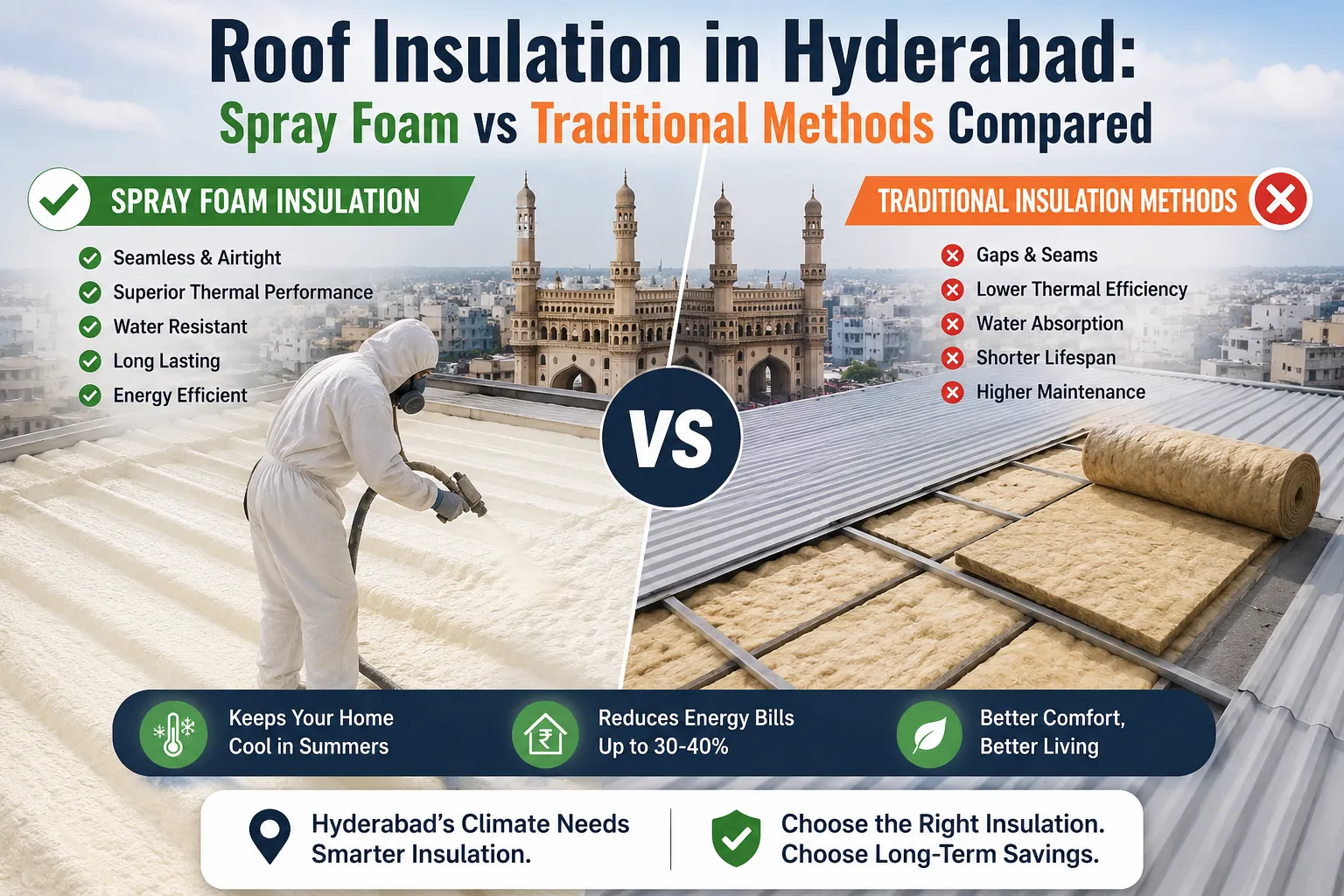
Hyderabad summers regularly push past 42°C, and for anyone with a bare RCC terrace, that heat doesn't stay outside. It soaks into the slab all afternoon and radiates into the rooms below well into the night. If you're weighing up how to fix that — for a home, a factory shed, or a commercial rooftop — you've probably come across two very different approaches: traditional brick bat coba, and spray-applied polyurethane foam (PUF). Here's how they actually compare.
The Traditional Approach: Brick Bat Coba
Brick bat coba has been the default roof treatment across Hyderabad and much of South India for decades. It's a layered system — broken brick bats set in a lime or cement mortar, given a slope for drainage, and finished with a screed. It does two jobs at once: waterproofing and a modest amount of thermal insulation, since brick and mortar have some inherent resistance to heat transfer.
It's a proven, well-understood method with a large base of contractors who can execute it. But it comes with trade-offs:
- Added dead load — the brick and mortar layer adds significant weight to the structure, which matters on older buildings or lightweight sheds.
- Thickness — achieving meaningful thermal resistance requires a thick layer, eating into terrace height or headroom below.
- Joint-dependent waterproofing — waterproofing performance depends heavily on workmanship at joints and slopes; cracks that develop over time can let water in even if the insulation value holds.
- Limited R-value — brick and mortar are decent conductors of heat compared to purpose-built insulation materials, so the thermal barrier is moderate rather than high-performance.
The Modern Approach: Spray Foam Roof Insulation
Spray-grade polyurethane foam is applied directly onto the roof surface as a liquid, where it expands and cures into a continuous, seamless closed-cell layer within seconds. Because it's sprayed rather than laid in blocks or bats, it conforms to the roof's exact contours — parapets, pipe penetrations, uneven surfaces — without the joints and seams that traditional layered systems depend on.
The key differences contractors care about:
- Seamless insulation layer — no joints means no weak points for water or heat to find a path through.
- Dual-function — closed-cell PU foam is inherently water-resistant, so a single application can serve as both a thermal barrier and a waterproofing layer, which is where spray foam's dual-benefit angle comes from.
- High R-value per inch — closed-cell PUF offers a notably higher thermal resistance per unit thickness than brick bat coba, meaning a much thinner layer achieves comparable or better heat reduction.
- Lightweight — a fraction of the dead load of a brick bat coba system, which matters for older structures or steel-sheet factory roofs that can't take much extra weight.
- Faster application — a spray crew can cover a large roof area in a day or two, compared to the multi-day curing and layering process of traditional coba work.
A heat-reflective topcoat is typically applied over the cured foam to protect it from UV exposure and add further reflectivity, which is what drives the temperature reduction contractors report on-site — commonly cited in the range of 6–8°C lower indoor temperatures compared to an untreated or traditionally insulated roof, depending on roof orientation, foam thickness, and building use.
Which Method Is Best for Hyderabad Summers?
For most residential and light commercial applications where terrace heat is the main complaint, spray foam tends to be the stronger fit specifically because Hyderabad's climate combines intense direct sun with a monsoon season — so a system that handles both heat and water in one continuous layer avoids the maintenance headaches of two separate systems ageing at different rates.
Brick bat coba still has a place — particularly on structures where the extra dead load isn't a concern and where local contractors are more readily available for repair work down the line. But for factories, warehouses with steel roofing, or homes where terrace height and roof loading are constraints, spray foam is generally the more practical option.
Does Roof Insulation Reduce Electricity Bills?
Reducing heat gain through the roof directly reduces the cooling load on air conditioning or fans, since the roof is typically the single largest source of heat gain in a top-floor space. The degree of savings depends on usage patterns, AC tonnage, and how much of the day the space is occupied, but a well-insulated roof consistently reduces the run-time needed to hold a comfortable indoor temperature.
How Long Does Spray Foam Roof Insulation Last?
With a quality heat-reflective topcoat and periodic recoating (typically every several years, depending on UV exposure and weather), spray-applied closed-cell PU foam roofing systems are designed for long service life. The topcoat is the wear layer that needs the most attention over time — the foam itself, once properly cured and protected from UV, is dimensionally stable and doesn't break down easily.
Is Spray Foam Insulation Waterproof Too?
Yes. Closed-cell polyurethane foam has a cellular structure that doesn't absorb water, and when sprayed as a continuous, seamless layer with no joints, it functions as an effective waterproofing membrane in addition to its insulation role. This is the core reason it's positioned as a dual-benefit system rather than requiring a separate waterproofing treatment.
What to Ask a Roof Insulation Contractor Before Hiring
- Do they use spray-grade PU foam formulated for roofing, or a generic foam not suited to sustained UV/weather exposure?
- What heat-reflective topcoat do they apply, and what's its expected recoat interval?
- Can they share the thickness they recommend for your roof type and usage, and why?
- Do they provide any workmanship or material warranty on the application?
Get a Free Roof Insulation Assessment
Whether you're comparing spray foam against brick bat coba or just trying to figure out why your top floor is unbearable by 3 PM, it helps to start with an actual site assessment rather than guesswork.
Get a free roof insulation assessment from Polyfix Trading →
Related reading: Thermal Insulation Solutions | Terrace Waterproofing Guide