

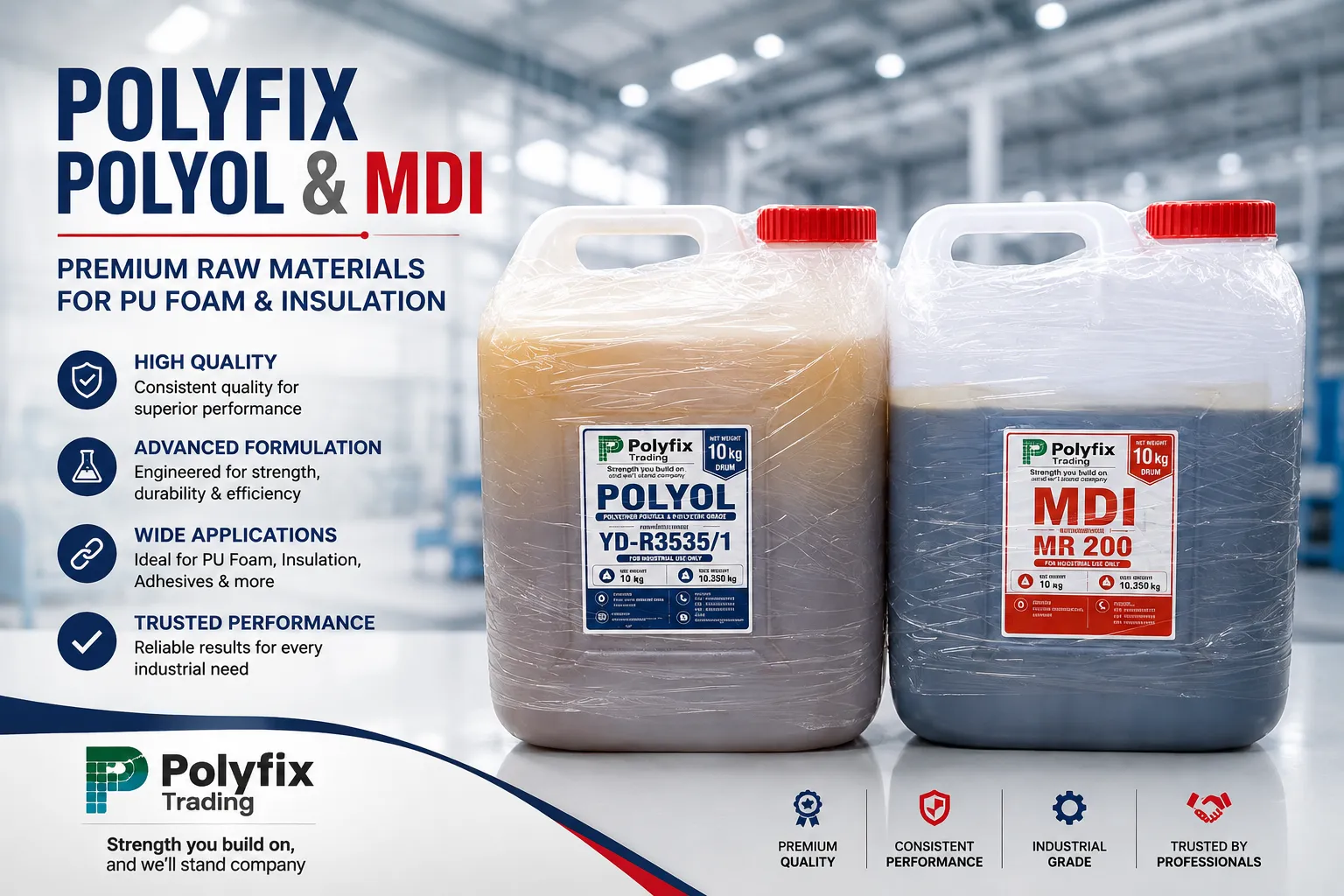
If you manufacture refrigerators, deep freezers, cold rooms, or any insulated cabinet, the single biggest factor separating a "good" product from a "premium" one is the PUF chemical you pour inside it. A poor-quality Polyurethane Foam Chemical means weak insulation, higher power bills for your customer, foam shrinkage, and warranty complaints. A well-engineered one means better K-factor, faster demoulding, and a product that holds temperature — and its reputation — for years.
This guide breaks down everything a manufacturer, OEM, or foam applicator in India needs to know about Refrigeration Grade Polyurethane Foam Chemical, using real technical data from Polyfix Trading's YD-R3535/1 Polyol + MR 200 MDI system as a reference point.
Refrigeration Grade PUF Chemical is a two-component rigid polyurethane foam system — a Polyol blend and an MDI (isocyanate) — that is mixed in a fixed ratio and injected into refrigerator or freezer cavities, where it expands and cures into a rigid, closed-cell insulating foam. It is supplied in matched sets (commonly 10 kg Polyol + 10 kg MDI, or larger drum/IBC packing) and is engineered specifically for low thermal conductivity, dimensional stability, and good flow into narrow cabinet cavities.
Why Polyurethane Foam Chemical Matters So Much in Refrigeration
Refrigerators and freezers work by keeping heat out. The compressor and refrigerant do the cooling, but it is the insulation foam sandwiched between the inner and outer cabinet walls that decides how hard the compressor has to work, how much electricity the appliance consumes, and how long it holds temperature during a power cut.
Rigid PU foam is preferred over older insulation materials because of its:
- Low thermal conductivity (K-factor) — the lower the number, the better the insulation
- High closed-cell content — closed cells trap gas and resist moisture, which is what actually blocks heat transfer
- Structural strength — rigid foam also adds mechanical rigidity to thin sheet-metal cabinets
- Fast processing — modern foam systems cure in minutes, not hours, which matters on a production line
This is exactly why appliance makers, cold room fabricators, and PUF panel manufacturers across India are actively searching for a dependable PUF Chemical Supplier in India rather than settling for whatever is locally available.
Understanding the Two-Component System: Polyol + MDI
Every rigid PU foam system, including refrigeration-grade formulations, is built from two components:
1. Polyol Component (e.g., YD-R3535/1)
The Polyol is a blend of polyether/polyester polyols, catalysts, surfactants, flame retardants, and (for refrigeration grade) a blowing agent — typically cyclopentane, added at the customer's end for safety and freshness reasons rather than pre-mixed at the factory.
Typical specification benchmarks for a good refrigeration-grade Polyol:
- Appearance: brown liquid
- Viscosity at 25°C: ~500 mPa·s
- Specific gravity at 25°C: ~1.02 g/cm³
- Water content: ~1.75%
2. MDI Component (e.g., MR 200)
MDI (Polymeric Diphenylmethane Diisocyanate) is the reactive isocyanate that combines with the Polyol during mixing to form the polymer matrix. It is generally supplied at a Polyol : MDI ratio of 100 : 135, though exact ratios vary by formulation.
When people search for a "Polyol and MDI Supplier in India," what they actually need is a supplier who supplies both components as a matched, tested system — not just individual chemicals bought separately, since mismatched batches lead to inconsistent foam density and poor demoulding.
Key Technical Parameters to Check Before Buying PUF Chemical
Whether you're evaluating Polyfix Trading or comparing multiple PUF Chemical Dealers in India, insist on seeing these numbers on the Technical Data Sheet — not just marketing claims:
| Parameter | Why It Matters |
|---|---|
| Free-rise core density | Indicates foam yield and material efficiency |
| Core density (moulded) | Directly affects insulation and structural strength |
| Compressive strength (vertical & parallel) | Determines how well the foam supports the cabinet structure |
| Dimensional stability (hot/cold cycling) | Predicts whether the foam will warp or shrink in real-world climate swings |
| Thermal conductivity / K-factor | The core number for energy efficiency — lower is always better |
| Closed-cell content | Above 90% is considered good for refrigeration insulation |
| Cream time, gel time, demould time | Determines production line speed and cycle time |
As a reference, a well-formulated refrigeration-grade system typically targets a core density around 35–40 kg/m³, compressive strength above 130 kPa, a K-factor around 20–21 mW/m·K, and closed-cell content above 93% — figures that directly translate into a refrigerator that holds its rated star energy efficiency for years, not just at the testing lab.
Machine Processing: What Manufacturers Should Expect
For consistent output on a refrigerator/freezer production line, a good foam system should process smoothly on standard high-pressure foaming machines, with:
- Polyol and MDI temperature maintained around 20°C
- Injection pressure in the range of 120–140 bar
- Mould temperature around 40–45°C
- Cream time in single digits to low double-digit seconds
- Demould time typically between 5–6 minutes, depending on cabinet size and foam thickness
A supplier who can share this level of processing detail upfront — rather than a vague one-page brochure — is generally a more serious, technically capable Refrigeration Grade PUF Chemical manufacturer.
Why Choose Polyfix Trading for Refrigeration Grade PUF Chemical
Polyfix Trading, an ISO 9001:2015 certified company based in Hyderabad, Telangana, supplies its YD-R3535/1 Rigid PU Foam System (Polyol) paired with MR 200 Polymeric MDI specifically engineered for refrigerator and freezer insulation.
What sets a system like this apart:
- Designed specifically for refrigeration & freezer cabinets — not a generic all-purpose foam repurposed for cold applications
- High insulation performance with a controlled, tested K-factor
- Stable processing across cream time, gel time, and demould cycles, reducing rejection rates on the line
- Good flowability and demouldability, even in narrow, complex cabinet geometries
- Consistent supply in 10 kg jerry cans as well as 200/250 kg drum and IBC/tank packing for larger manufacturers
- Environment-conscious formulation, aligned with current industry movement toward lower-GWP blowing agents like cyclopentane
Whether you run a large appliance factory or a regional cold-room fabrication unit, working with a manufacturer that treats Polyurethane Foam Chemical as a precision-engineered product — with a documented data sheet, storage guidelines, and QC parameters — reduces your production headaches significantly.
Storage & Handling Best Practices
Even the best PUF chemical will underperform if stored incorrectly. General best practice:
- Store between 15–25°C, away from direct sunlight and heat sources
- Keep drums tightly sealed in a dry environment
- Protect from humidity, food, animal feed, and oxidising materials
- Use within the stated shelf life (commonly around 12 months under proper storage)
- Always run a hand cup test (small-batch mixing test) before a full production run to confirm cream time, gel time, and free-rise density match the data sheet
Frequently Asked Questions
Q1. What is PUF Chemical used for?
PUF (Polyurethane Foam) Chemical is used as rigid insulation foam, most commonly inside refrigerators, freezers, cold rooms, insulated panels, and pipe insulation. It is poured or injected between two surfaces, where it expands and hardens into a rigid, closed-cell insulating layer.
Q2. What is the difference between Polyol and MDI?
Polyol and MDI are the two components of a polyurethane system. Polyol is the resin-side blend containing catalysts, surfactants, and blowing agents. MDI is the isocyanate that reacts with the Polyol to form the rigid polymer foam. Both must be sourced as a matched, compatible pair for consistent results.
Q3. What is a good mixing ratio for refrigeration grade PUF chemical?
Mixing ratios vary by formulation, but a common benchmark for refrigeration-grade systems is around 100 parts Polyol to 135 parts MDI by weight, with cyclopentane blowing agent added separately at the customer's end.
Q4. Is Polyfix Trading a genuine PUF Chemical Supplier in India?
Yes. Polyfix Trading is an ISO 9001:2015 certified company based in Hyderabad, supplying Refrigeration Grade Polyurethane Foam Chemical (YD-R3535/1 Polyol + MR 200 MDI) in 10 kg packs as well as bulk drum/IBC packing for refrigerator and freezer manufacturers across India.
Q5. How do I know if a PUF chemical is good quality?
Check the Technical Data Sheet for core density, compressive strength, thermal conductivity (K-factor), closed-cell content, and dimensional stability under heat/cold cycling. Always request a hand cup test sample before committing to bulk orders.
Q6. What is the shelf life of Polyurethane Foam Chemical?
Under proper storage conditions (15–25°C, sealed, dry, away from humidity), refrigeration-grade PUF chemical typically has a shelf life of around 12 months.
Final Word
India's cold-chain, refrigeration, and appliance manufacturing sectors are expanding fast, and demand for dependable, well-documented Refrigeration Grade Polyurethane Foam Chemical is growing right alongside it. If you're comparing a Polyol and MDI Supplier in India for your next production run, don't just compare price per kilogram — compare K-factor, closed-cell content, dimensional stability, and whether the supplier actually hands you real processing data instead of a sales pitch.
Polyfix Trading — Strength you build on.
📍 1-16-091, New Bowenpally Main Road, Opp. Delhi Mithai Bhandar, Secunderabad, Hyderabad – 500011, Telangana, India 📞 +91 87900 89111 | +91 99630 48835 | +91 99662 52927 ✉️ sales@polyfixtrading.in 🌐 www.polyfixtrading.in