

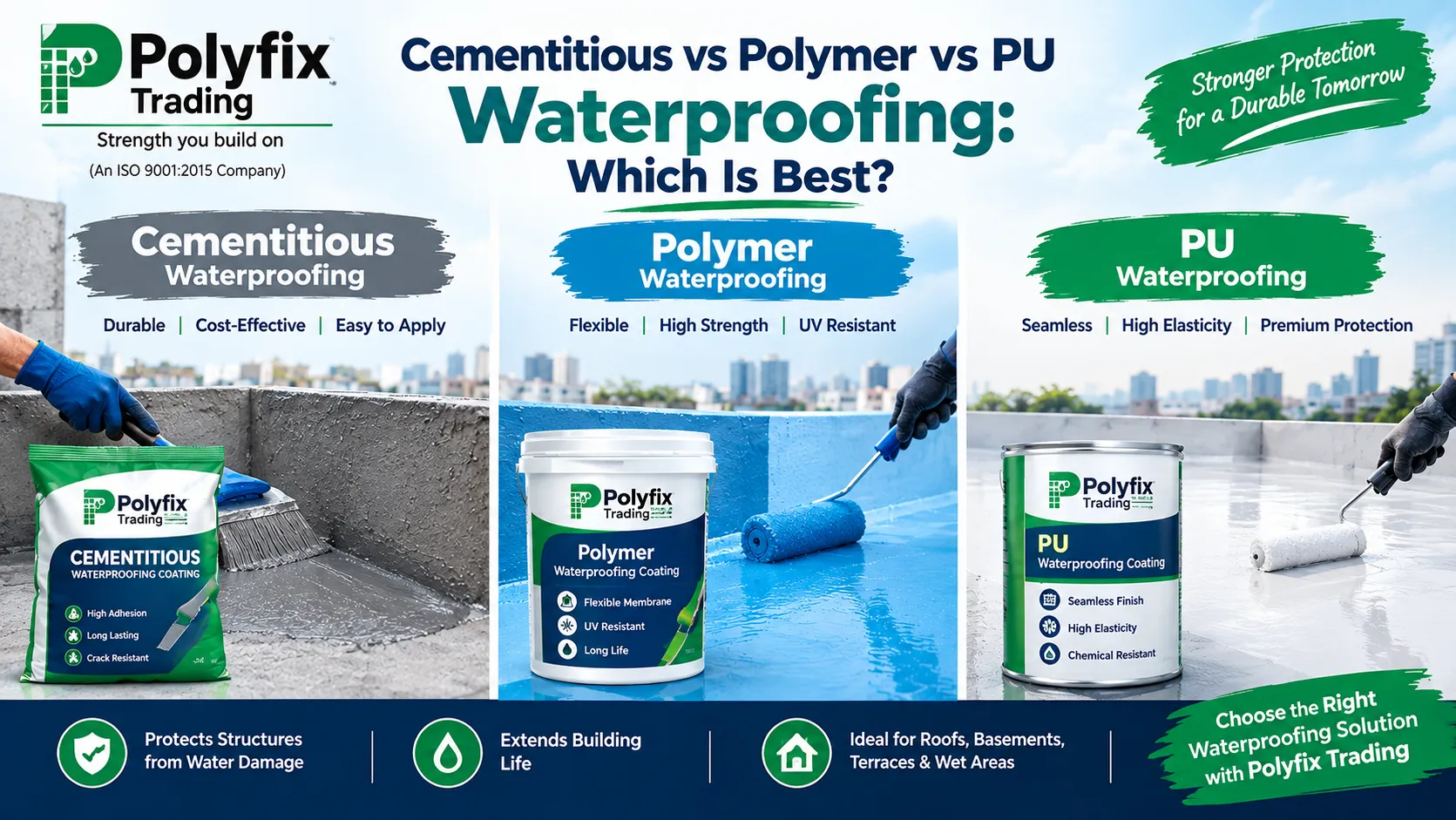
Cementitious waterproofing chemicals are rigid, mixed with cement or applied as a slurry, and suit water tanks and below-ground structures; polymer-modified coatings (like acrylic elastomeric membranes) are flexible, brush- or roller-applied, and suit roofs and terraces; PU (polyurethane) waterproofing systems offer high elasticity and crack-bridging, suiting exposed roofs and expansion joints in Hyderabad's mix of monsoon rain and summer heat. There's no single "strongest" option — the right chemical depends on the surface, exposure, and whether flexibility or rigidity matters more for that specific application.
Search for "best waterproofing chemical" and you'll find three families competing for your attention — cementitious, polymer-modified, and polyurethane (PU) — often described in ways that make each sound like the universal answer. In practice, they're not competing solutions for the same job; they're different tools built around different chemistry, each suited to a different part of a building. Understanding that difference is what actually prevents leaks, rather than picking whichever product ranks highest in an ad.
This guide compares all three on the properties that matter for a Hyderabad property — flexibility, application method, surface suitability, and how they hold up against local weather — so you can match the chemistry to the job instead of guessing.
Key Takeaways
- Cementitious waterproofing chemicals are rigid systems, often mixed directly into concrete or mortar (integral) or applied as a cement-based slurry, and are well suited to water tanks, basements, and below-ground structures where a hard, permanent bond matters.
- Polymer-modified coatings — such as acrylic elastomeric membranes — are flexible, brush- or roller-applied systems well suited to roofs and terraces, where crack accommodation and UV resistance matter more than rigidity.
- PU (polyurethane) waterproofing systems offer high elasticity and strong crack-bridging performance, making them a common choice for exposed roofs, expansion joints, and areas with significant thermal movement.
- Hyderabad's climate — heavy monsoon rainfall alongside intense summer heat — puts real demand on both flexibility (to handle thermal expansion/contraction) and UV resistance (for exposed surfaces), which is why the "right" choice depends on which surface is being treated.
- Polyfix Trading stocks products across all three categories — including Fosroc Brushbond and UltraTech Weather Pro — and can help match the right chemistry to your specific project.
What Is the Strongest Waterproofing Chemical?
There isn't a single "strongest" waterproofing chemical in the way there might be a single strongest grade of steel — because cementitious, polymer, and PU systems aren't competing on the same property. Cementitious systems are strong in the sense of rigidity and permanent bonding to concrete; PU systems are strong in the sense of elasticity and crack-bridging under movement; polymer-modified coatings sit between the two, offering flexibility with easier site application than PU.
The more useful question isn't "which is strongest" but "which property does this specific surface need" — rigidity, flexibility, UV resistance, or a specific application method. That's the basis for the comparison below.
Cementitious Waterproofing Chemicals
Cementitious waterproofing works by either being mixed directly into concrete/mortar during construction (integral waterproofing) or applied afterward as a cement-based coating or slurry. Because it's cement-based, it bonds permanently with the concrete substrate and forms a rigid, non-flexible layer.
Integral waterproofing compounds — admixtures added to the concrete or mortar mix itself — are a well-established category in India, governed by the IS 2645 standard for integral waterproofing compounds for cement mortar and concrete. UltraTech Weather Pro WP+200 is one such system: it's an integral waterproofing liquid that uses a Water Block Technology to fill tiny holes in concrete, plaster, and mortar, breaking the interconnectivity of capillaries and reducing water penetration. It's added to plaster, mortar, and concrete from foundation to finishing — including foundation concreting, beams, columns, brick joining, and both external and internal plastering.
This integral approach is why cementitious chemicals are strongly associated with water tanks, basements, and below-ground structures — the waterproofing becomes part of the concrete itself, rather than a separate surface layer that could be damaged or worn away over time.
Where cementitious waterproofing fits best: water tanks, basements, foundations, retaining walls, and any application where the concrete needs to resist water pressure from a fixed, permanent structure rather than accommodate ongoing movement.
Polymer-Modified Coatings
Polymer-modified waterproofing coatings — typically acrylic-based elastomeric systems — are applied as a liquid membrane over the surface, usually in multiple coats. Unlike cementitious systems, they're formulated to remain flexible after curing, which allows them to accommodate minor surface movement and hairline cracking without failing.
Fosroc Brushbond Roofguard is a representative example of this category. It's a high-build, fibre-reinforced, seamless waterproofing render suitable for waterproofing old and new roofs — a polymer-based product applied in three or more coats, each coat in a different colour so the correct thickness can be monitored during application. It can be applied directly onto existing sound concrete, brickbat coba, or screed concrete without removing the old surface, provided the substrate is stable enough, which avoids the risk of damage associated with stripping old roof overlays. The system builds a dry film thickness of more than 1mm across three coats, provides an excellent barrier to carbon dioxide, chloride, and sulphate ions, and offers good crack accommodation capacity.
This combination — bonding to existing surfaces without removal, plus the ability to accommodate minor cracking — is why polymer-modified coatings have become a default choice for terrace and roof waterproofing repair work in India, where re-coating an existing roof is far more common than a full tear-off and rebuild.
Where polymer-modified coatings fit best: roofs, terraces, and exposed concrete where the surface needs a flexible, UV-resistant membrane that can be applied without major surface removal.
PU (Polyurethane) Waterproofing Systems
Polyurethane waterproofing systems are liquid-applied membranes that cure into a highly elastic, seamless layer. Compared to acrylic polymer-modified coatings, PU systems generally offer greater elongation and elasticity, which makes them particularly effective at bridging cracks that continue to move after the coating has cured — a common scenario around expansion joints, parapet junctions, and areas subject to significant thermal expansion and contraction.
Because PU chemistry is also the basis for expanding PU foam sealants used in gap-filling and pipe/joint sealing work — a category Polyfix Trading also supplies under its own PUF chemical range — the same underlying flexibility and adhesion properties that make PU useful for filling irregular gaps also make it effective as a waterproofing membrane material on surfaces that move.
Where PU waterproofing fits best: exposed roofs with significant thermal cycling, expansion joints, terraces where crack-bridging under ongoing movement matters more than raw rigidity, and repair scenarios where a highly flexible membrane needs to bond over an existing, imperfect surface.
Cementitious vs. Polymer vs. PU: Side-by-Side Comparison
| Property | Cementitious | Polymer-Modified | PU (Polyurethane) |
|---|---|---|---|
| Flexibility | Rigid, minimal flexibility | Flexible, moderate crack accommodation | Highly elastic, strong crack-bridging |
| Typical application | Mixed into concrete/mortar (integral) or applied as slurry | Brush/roller-applied liquid membrane, multiple coats | Liquid-applied membrane, cures to a seamless elastic layer |
| Bond to substrate | Permanent, becomes part of the concrete | Strong surface bond, including over old roofs without removal | Strong surface bond, suited to surfaces with ongoing movement |
| Best suited to | Water tanks, basements, foundations, below-ground structures | Roofs, terraces, exposed concrete needing UV resistance | Expansion joints, roofs with thermal movement, crack-prone areas |
| UV / weathering resistance | Not directly exposed (below-ground or internal use) | Good, formulated for exterior exposure | Good, suited to continuously exposed surfaces |
| Typical Hyderabad use case | Water tank and foundation waterproofing during construction | Terrace and roof waterproofing repair on existing buildings | Expansion joints and roofs needing high elasticity |
Which Waterproofing Chemical Suits Hyderabad's Climate?
Hyderabad's climate combines a distinct monsoon season with intense summer heat, which puts two separate demands on any waterproofing system: it needs to handle standing water and sustained rainfall during the monsoon, and it needs to survive UV exposure and thermal cycling through the summer without cracking or degrading.
This is generally why:
- Water tanks and underground structures — less exposed to UV and thermal cycling, but under constant water pressure — are typically treated with cementitious integral or applied systems.
- Roofs and terraces, which face both monsoon water accumulation and direct summer sun, are commonly treated with polymer-modified coatings for their balance of flexibility and UV resistance.
- Expansion joints and roofs with a history of cracking — where thermal expansion and contraction is a recurring issue — often benefit from PU systems specifically because of their higher elasticity.
In practice, many Hyderabad buildings end up using more than one category across different parts of the same structure, rather than a single product for the entire building.
Is PU Waterproofing Better Than Cementitious?
Neither is universally "better" — they solve different problems. PU waterproofing offers superior flexibility and crack-bridging, which makes it the better choice where ongoing movement is the primary concern. Cementitious waterproofing offers permanent, rigid bonding to concrete, which makes it the better choice for structures like water tanks that need to resist constant water pressure rather than accommodate movement. Choosing between them should be based on the specific surface and exposure conditions, not a general assumption that one chemistry outperforms the other in every scenario.
Are PU Waterproofing Chemicals More Expensive?
PU-based waterproofing systems generally sit at a higher price point than standard cementitious or polymer-modified options, reflecting the more complex chemistry and higher elasticity they deliver. Whether that added cost is justified depends on the application — for a water tank with no significant movement, a cementitious system may deliver equivalent long-term performance at a lower cost, while for an expansion joint or a roof with recurring crack issues, PU's elasticity can prevent repeat repair costs that would otherwise offset the price difference.
Can Waterproofing Chemicals Be Mixed With Cement Directly?
Yes — this is exactly how integral cementitious waterproofing compounds are used. Products in this category, such as UltraTech Weather Pro WP+200, are added directly to plaster, mortar, and concrete during mixing, rather than applied as a separate coating afterward. This is different from polymer-modified and PU systems, which are applied as surface coatings or membranes after the concrete or structure is already in place, rather than mixed into the material itself.
How Long Do Waterproofing Chemical Coatings Last?
Longevity depends heavily on the product category, application quality, and exposure conditions, so it's not accurate to quote a single fixed lifespan across cementitious, polymer, and PU systems. In general, integral cementitious waterproofing becomes part of the concrete and doesn't wear the way a surface coating does, while polymer-modified and PU surface coatings are exposed to weathering and foot traffic over time and may require re-coating on a maintenance cycle. For a specific expected service life relevant to your project, it's worth checking the technical data sheet for the exact product you're considering, or asking your supplier directly.
Buy Cementitious, Polymer & PU Waterproofing Chemicals in Hyderabad
Polyfix Trading stocks waterproofing chemicals across all three categories — including Fosroc Brushbond polymer-modified coatings, UltraTech Weather Pro cementitious systems, and PU-based products — for contractors, builders, and homeowners across Hyderabad and Secunderabad. Because the right chemical depends on the specific surface and exposure conditions of your project, our team can help match the correct category and product to your requirement rather than defaulting to a single "one size fits all" recommendation.
For more on choosing the right product for a specific area of your home, see our bathroom waterproofing guide and our building construction chemicals supplier guide.
Frequently Asked Questions
Can waterproofing chemicals be mixed with cement directly?
Yes. Integral waterproofing compounds, such as UltraTech Weather Pro WP+200, are designed to be added directly to plaster, mortar, and concrete during mixing, becoming part of the structure itself rather than a separate surface coating.
How long do waterproofing chemical coatings last?
Longevity varies by product category and exposure — integral cementitious waterproofing becomes part of the concrete and doesn't wear like a surface coating, while polymer-modified and PU surface coatings are exposed to weathering and may need re-coating over time. Check the specific product's technical data sheet for expected service life.
Are PU waterproofing chemicals more expensive?
Generally, yes — PU systems typically cost more than standard cementitious or polymer-modified options due to their higher elasticity and more complex chemistry. Whether the added cost is worthwhile depends on whether the application genuinely needs PU's superior crack-bridging performance.
Ask our experts which waterproofing chemical suits your project. Browse waterproofing chemicals at Polyfix Trading →