

Professional cementitious waterproofing coating services using IS 2645-compliant and brand-certified systems — for roofs, water tanks, basements, and wet areas across Hyderabad.
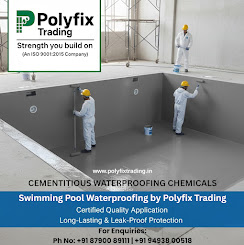
Cementitious waterproofing is one of the most widely specified waterproofing methods in Indian construction — not because it's the most advanced chemistry available, but because, applied correctly to the right surface, it's genuinely one of the most reliable and cost-effective ways to protect concrete from water penetration. Polyfix Trading applies cementitious waterproofing systems from Fosroc, UltraTech, and BondTuf, matched to the specific surface and exposure condition rather than a single generic mix.
Cementitious waterproofing is a coating or admixture built around a cement-based binder combined with sand and specialized waterproofing additives — polymers, pore-blocking agents, or crystalline compounds, depending on the specific product. Once applied or mixed in, it forms a layer that becomes chemically and mechanically bonded to the concrete substrate, reducing water penetration while adding minimal rigidity change to the structure, since the coating is fundamentally the same cement chemistry as the concrete it's protecting.
This compatibility is the main reason cementitious systems are used so widely: unlike a membrane or film-forming coating that sits on top of concrete, a cementitious system bonds into it, which is part of why it performs reliably on below-grade and water-retaining structures where a surface-only membrane would be more vulnerable to damage or detachment.
Cementitious waterproofing chemistry is used in construction in two distinct ways, and it's worth knowing the difference:
Some projects use both — an integral admixture at the concreting stage, followed by a surface-applied cementitious coating at specific high-risk points like wet areas or water tank interiors.
A specific category within cementitious waterproofing — crystalline waterproofing — uses active chemicals that react with the moisture already present in concrete to form non-soluble crystalline deposits inside the pore structure, physically blocking the path water would otherwise travel through. Because this reaction requires moisture to trigger it, crystalline systems can continue reacting (and effectively self-heal around minor future cracking) whenever water reaches previously unreacted material within the concrete — a property that makes this sub-type particularly suited to structures under constant water pressure from one side, such as reservoirs, tunnels, and below-grade retaining structures.
Cementitious systems are suited to a specific set of structures — generally those bonded permanently to concrete and either below-grade or holding water — including:
Cementitious waterproofing is the right choice specifically where the surface is constantly exposed to water or moisture and doesn't experience significant ongoing movement — water tanks, basements, foundations, and retaining walls being the clearest examples. Its rigidity, which would be a drawback on a roof subject to daily thermal expansion, is an advantage here: there's no flexible film to degrade, peel, or lose adhesion under constant hydrostatic pressure.
For projects in Hyderabad specifically, this durability matters across both major seasonal conditions the city sees — cementitious systems used on below-grade and water-retaining structures aren't exposed to the summer UV and thermal cycling that drives wear on surface coatings, which is part of why they hold up reliably over multiple monsoon cycles without needing frequent recoating, provided the correct product and application thickness were used from the start.
At Polyfix Trading, we offer:
We ensure that every project is executed with attention to the details that actually determine whether cementitious waterproofing performs for years or fails within a single season — correct surface preparation, correct dosage or coat thickness, and adequate curing time before the structure is put back into use.
Cementitious waterproofing can be used on roofs, but because roofs experience significant thermal expansion and contraction, a purely rigid cementitious coating is more prone to cracking there than on a water tank or basement. For exposed roofs, we often recommend pairing a cementitious base with a flexible polymer-modified or PU-hybrid top coat, or selecting a flexible cementitious system specifically formulated for roof exposure.
An integral admixture is mixed directly into concrete or mortar before it's poured, becoming part of the structure itself. A surface-applied cementitious coating is brushed or trowelled onto already-cured concrete afterward. Some projects use both together — an integral admixture during construction, plus a surface coating at specific high-risk areas.
Properly applied cementitious waterproofing, especially integral systems that become part of the concrete, can last as long as the structure itself with minimal maintenance, since it doesn't wear the way a surface film does. Surface-applied cementitious coatings in exposed or high-traffic areas may need periodic inspection and recoating as part of routine building maintenance.
Yes, this is one of cementitious waterproofing's primary applications, since it bonds permanently to concrete and is compatible with sustained water contact. Application is typically scheduled during a tank's routine cleaning or maintenance window, with adequate curing time before the tank is refilled.
Looking for reliable cementitious waterproofing coating services? Polyfix Trading is here to help.
📍 1-16-091, New Bowenpally, Main Road, Opposite Delhi Mithai Bhandar, Secunderabad, Hyderabad – 500011, Telangana, India
📧 sales@polyfixtrading.in | polyfixtrading@gmail.com
📞 +91-8790089111 | +91-9963048835 | +91-9966252927